

Hi, I’m Cory.
For almost 30 years, I’ve been entrusted by Community Bank training organizations like the Barrett School of Banking, as well as global brands like Nike, the World Health Organization, and the Special Olympics, to sharpen their lens with investors.

Today, I help community banks turn buried institutional knowledge into a practical AI operating foundation—so teams can use AI with more clarity, consistency, and trust.
“It’s rare to find someone with the technical skillset as well as the brand awareness mentality… Cory’s been a huge help to me in rethinking the entire model re: AI and what it actually can/can’t do.”
Byron Earnheart & Chris Kelley (Barret School of Banking)
First, you have to understand that this is a new type of human software that gets installed into the core of your business (that’s why I call it an OS). It is not a storytelling course, personal branding playbook, ghostwriting service, or content marketing tactics. This is deep business infrastructure for true durability in the age of AI.
Storytelling OS is a 3‑layer operating system for your narrative, turning your tacit expertise into a growth engine for your business. Think of it as the source code for your story and your marketplace value-creation and capture engine.
You’re probably sitting on a killer methodology. It’s what keeps you expensive. But right now, that methodology is trapped in your head, scattered across Miro boards, or buried in old Zoom transcripts.
So when you try to use AI, it has nothing proprietary to reference. It defaults to the internet’s average.
In front of your existing clients, you’re winning—but in your proposal deck, and when attracting new clients, you sound like everyone else.
If your AI output feels like a smart junior consultant, that’s a problem.
Clients are starting to notice. The generic nature of it all will erode your pricing power, if it’s not already.
The thing is, you don’t need better prompts or another course on “how to learn AI.”
What you need is better infrastructure.
Storytelling OS is that infrastructure.
Storytelling OS is the connectivity engine.
The Human–AI Connect Framework is the philosophy.
Together, they ensure that as you scale with AI, you actually become more human, not less.
This isn’t about policing AI or drawing lines where it’s “forbidden” to go—that’s fear-based thinking. Instead, we build connectivity channels that invite AI into the creative process as a collaborator, widening your lens rather than narrowing it.
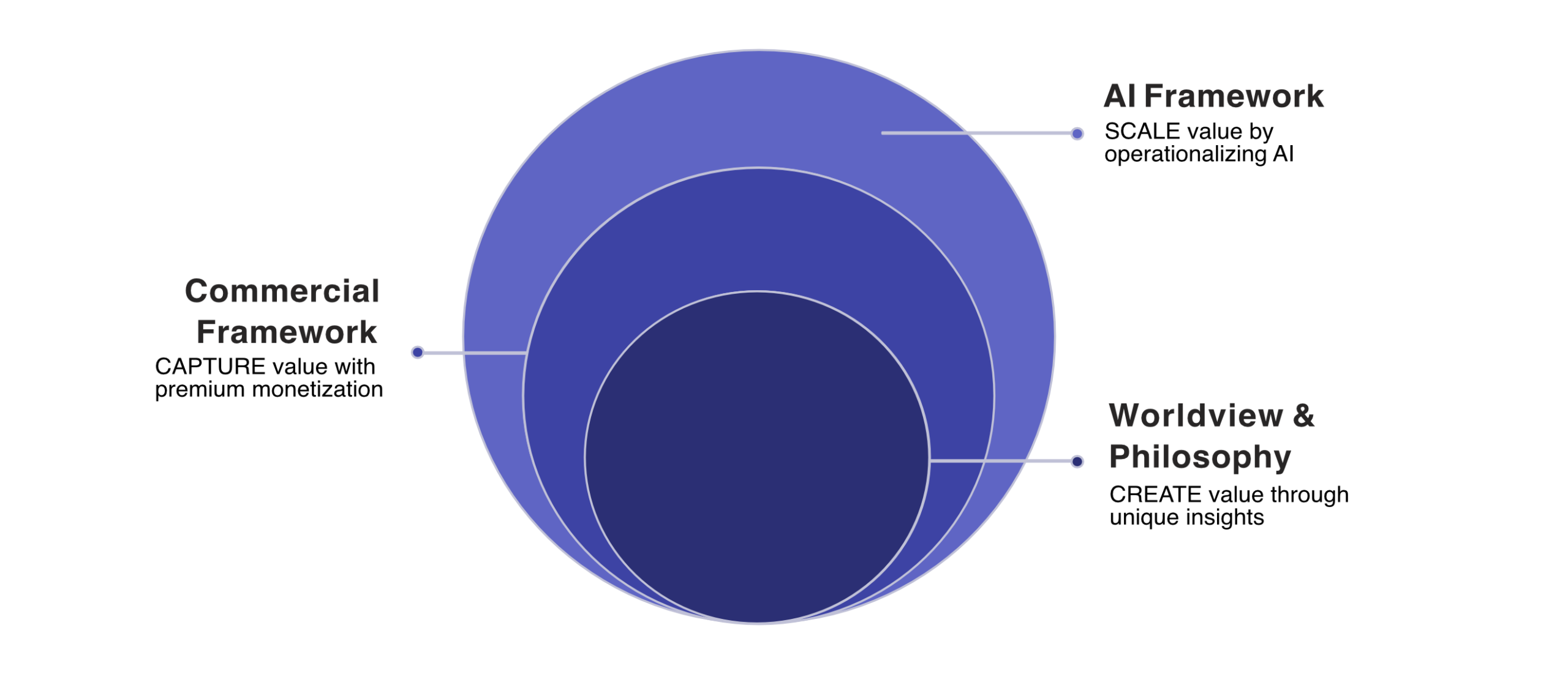
Value Creation: “The Strategic Narrative.” We define the market conflict only you can solve. This becomes the ‘Source Code’ for every keynote, pitch, and proposal.
The “Source Code” of your philosophy. Your beliefs, your enemies, and the specific lens you use to view the market.
• Your beliefs
• point of view
• narrative architecture.
• What you stand for.
• What you stand against.
This is your manifesto—the contrarian positioning that makes clients say “this is exactly what I’ve been looking for.”
Without this layer, AI produces competent work with no edge, no opinion, no YOU.
With it, AI generates insights that feel like they could only come from your brain.
We’ll:
• Name the real villain in your customer’s world (not a vague concept).
• Anchor your POV in urgent, expensive, lived problems your buyers already feel.
• Capture the language and non‑negotiables that define your taste—what you will never say or recommend
Value Capture: “The Revenue Architecture.” A licensed product definition. We turn ‘consulting’ into a tradeable asset (e.g., The [YourName] Protocol™).
Your proprietary methodology, formalized. We turn your “process” into a named, trademarkable system with clear steps, pricing logic, and diagnostic frameworks.
You stop selling “hours” and start selling “products.” This layer gives you the structural leverage to increase fees by 2-3x because you are selling a system, not a person.
Without this layer, you’re just doing consulting.
With it, you have a defensible method that justifies premium pricing.
Value scaling: Create new offers, enter new positioning territory, produce IP-driven products—all with AI that maintains your differentiation.
The bridge between your brain and the machine. Custom system instructions and guardrails that force the AI to reference Layer 1 and 2 before it writes a single word.
The Result: You can finally scale. Your junior team (or your AI agent) can produce senior-level strategy documents because they are operating inside your guardrails.
Custom prompts, system instructions, and guardrails that enforce your logic.
We take Layers 1 and 2 and encode them into your LLM (Gemini, Claude, ChatGPT—your choice).
This is AI that operates on YOUR proprietary infrastructure
It turns your “AI assistant” into AI that operates on YOUR proprietary infrastructure.
So when you use AI it:
Thinks with your philosophy
Applies your methodology
Generates outputs only YOU could sign
There are really only two places where AI creates defensible value:
1. Proprietary data (Most consultants don’t have this)
2. Proprietary expertise (You have this—but it’s not codified)
AI’s are trained on public information— textbooks, the internet, anything freely available.
What they DON’T have is the stuff people learn after they leave school:
• The hard-won knowledge from doing a job for 10-20 years
• The instincts and judgment calls
• The patterns that were never written down
• The contrarian POV that makes clients say “finally, someone gets it”
If you can encode THAT expertise into AI— the workflows, the context, the way decisions are actually made in your specific domain— you’ve got something defensible.
While everyone else is building on the same foundation (ChatGPT’s training data and basic prompts).
But the true Moat Builders are building on top of something only THEY can access: Their proprietary methodology, their documented worldview, their operating system.
That’s how to create new value. That’s how to capture it at premium prices and remain expensive while AI erodes value for everyone else.
Most people try to bolt AI onto their business from the Outside-In (Tools, Prompts, Hacks).
We build your OS from the Inside-Out: Built on your values, stories, judgment, and decades of experience.
You are a premium expert with high discernment. You want to leverage AI, but you’re terrified it will make you sound generic, flatten your edges, and disconnect you from what makes your work valuable.
You’re facing a Fidelity Gap:
Your best thinking is jagged, human, and deep.
AI defaults to smooth, average, and shallow.
Without a connectivity system to bridge that gap, you’re forced to choose:
Do it manually (and stay small)
Use AI as-is (and sound like everyone else)
Storytelling OS gives you a third option: Use AI as a thought partner that pattern-matches across your knowledge base, challenges assumptions, and finds insights you can’t see alone. That’s the system I help you build.
You might be wondering: “Ok, this sounds great, but how do I use Storytelling OS with my AI (and in my overall marketing) to create and capture new value in the marketplace?”
 VALUE CREATION
1. Invent New Types of Offers – Your unique framework helps you design IP-driven products that didn’t exist before. Not “another workshop”—entirely new positioning territory. Example: A sales consultant used their Moat Builder OS to create a “Revenue Architecture Assessment” that commands $15K (vs. their old $5K “sales audit”).
2. Enter New Market Categories – Your documented worldview lets you claim category-shaping positioning. You’re not “one of many”—you’re the person who defined the category. Example: A fractional CMO went from “marketing help” to “AI-proof brand architecture”—a category they now own.
3. Generate Differentiated Content at Scale – With your philosophy + methodology encoded in AI, you can produce 10x more content that still feels distinctly YOU. Not generic LinkedIn posts. Real IP that builds authority.
 VALUE CAPTURE
4. Command Premium Pricing – Don’t sell hours, sell a method. Documented IP justifies 2-3x higher rates because buyers see a defensible system, not just experience.
5. Enable Licensing & Training Revenue – Your frameworks become teachable assets.
You can:
6. Increase Exit Value – Documented, transferable IP dramatically increases business valuation. Buyers pay for systems, not just founder expertise.
7. Reduce Delivery Cost – Your team (or AI) can execute without you in every conversation. Scale revenue without scaling hours.
Moat Builder OS sits at the center of this: It’s the documented infrastructure that makes new value creation possible and value capture systematic.
“Why do I sound generic?”
For founders who want a quick diagnostic without the full build.
What you get:
Investment: $1,500 (48-hour turnaround)
“I want my voice to scale.”
The complete build. We extract, codify, and install your system.
“Run this for me.”
I act as your Chief Narrative Officer. I manage the OS, oversee your content strategy, and ensure your story evolves as you grow.
Investment: $3,000 – $5,000 / month (Retainer)
Because right now, you are paying a ‘Time Tax’ every time you wrestle with AI.
You spend 45 minutes fixing a 5-minute draft.
The Storytelling OS eliminates that tax.
The sooner you install it, the sooner you stop working for your tools and let the tools for you.
Remember: You’re not buying calls, PDFs, prompts, courses, or tactics. You’re buying infrastructure for your business that you can build on year after year, that gives you a clear story, a clear method, clear messaging for your ICP, clear instructions for your AI, and a clear way to scale.
Why this feels like a bargain (even at a premium):
Tom Armes’ “Pricey vs. Bargain” test says offers feel like a bargain when they solve hard, expensive, urgent problems—not when they list activities.
Storytelling OS hits all three:
1. Hard problem: Codifying your worldview, method, and discernment into a system humans and AI can use is genuinely hard to do alone.
2. Expensive problem: Right now, fuzzy narrative and untrusted AI cost you:
Lost premium deals (buyers can’t see why you’re different).
Days per month lost to manual rewriting and “content tinkering.”
Underpriced work because you can’t point to a clear method.
3. Urgent problem: Your top competitors are already tightening their stories and training their models. Every quarter you wait, the gap widens. If Storytelling OS helps you close even one extra flagship client or launch a new premium offer with confidence, it more than pays for itself.
If you’re not sure if you need the Full OS Install…
Most buyers know they need the full installation. But if you’re thinking:
• “Do I even have a moat problem?”
• “What exactly should I build first?”
• “Is this the right investment for me right now?”
Start with one of these options:
For the expert who just wants the "Code." Includes: All 3 finished Frameworks (You write them, I edit them). No AI installation.
We don’t just “consult.” We build and install the assets for you.
WEEK 1: Extraction
I interview you to mine your tacit knowledge. I ask the hard questions that pull your genius out of your head and onto paper.
WEEK 2: Codification (The Source Code)
I write your Worldview Bible and Narrative Architecture. This is the document you’ve always wanted but never had time to write.
WEEK 3: Installation (AI Setup)
I configure your LLM (Claude/ChatGPT) with your custom instructions. I hand you the keys to a system that thinks like you.
WEEK 4: Testing, troubleshooting, training
We tweak anything you’re not happy with, find bugs in the OS, and train you to scale the system.
By the end, you’ll have:
→ A documented moat AI can’t replicate
→ Proprietary frameworks that justify premium pricing
→ New value creation capability in the marketplace
→ A scalable system that works without you in the room
→ The answer to: “How do I use AI to create new value?”
Your beliefs, POV, narrative architecture, contrarian positioning. This is your value CREATION engine.
Custom system instructions, prompt templates, guardrails. This is your value SCALING infrastructure.
Step-by-step guide: how to use the OS, when to reference which framework, how to evolve it over time.
Async support via email/Slack for refinements and optimization.
Your 3-step methodology, pricing model, revenue engine, customer journey architecture. This is your value CAPTURE system.
We install your OS in your chosen platform (Gemini/Claude/ChatGPT). You get a project folder with 10-12 foundational documents that AI references every time you prompt.
(90 minutes) Live walkthrough with your key stakeholders.
One-page visual showing your complete operating system. Use it for investor conversations, client proposals, internal alignment.
From regulated banking institutions to boutique strategy firms, the goal is to turn tacit genius into explicit assets.
Inês NW (Strategist)
“Cory led the whole workshop with an incredible Miro board, going through every single step… He weaves and twists all these stories into a grand vision. It inspires me that I can do this too.”
Lauren Gibson (Founder)
“It’s hard to come up with not-so-common ideas… but your frameworks helped me do that. My article got so much attention because it wasn’t just ‘performance marketing’—it really resonated.”
Eva Žáčková (Marketing at elin.ai)